
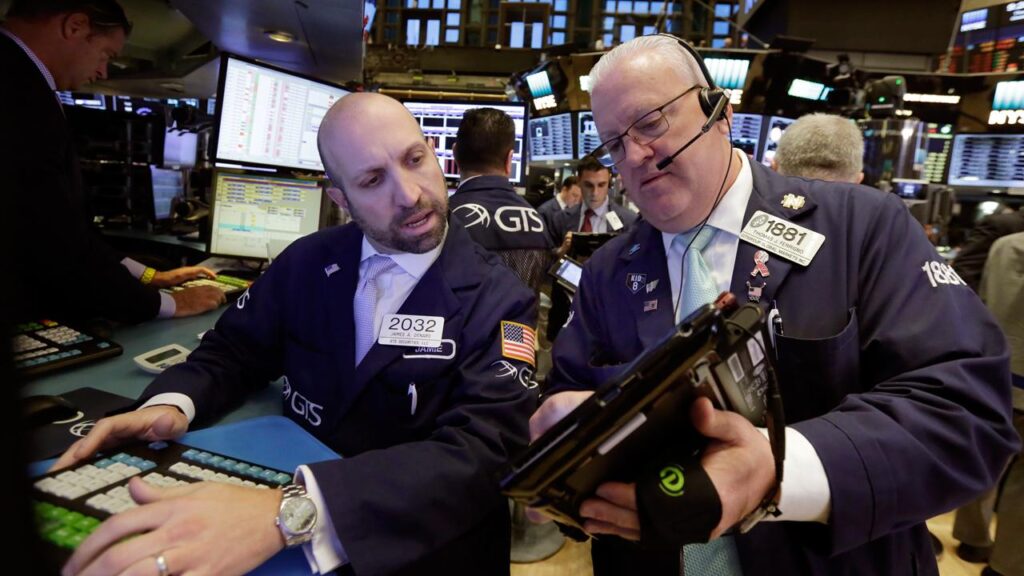
Stocks finish higher but end the week with a loss
Stocks ended the day higher but finished lower for the week. Investors are weighing inflation data against the possibility of more aggressive interest rate hikes by the Federal Reserve.
Meanwhile, energy shares jumped on higher oil prices.
• The Dow Jones Industrial Average was up 0.53%.
• The S&P 500 added 0.59%.
• The Nasdaq Composite rose 0.21%.
A Commerce Department report showed U.S. consumer spending barely rose in November, while inflation cooled further, but not enough to discourage the U.S. Federal Reserve from driving interest rates to higher levels next year.
The personal consumption expenditures (PCE) price index, the Fed’s preferred inflation gauge, rose 0.1% last month after climbing 0.4% in October.
A benchmark survey showed U.S. consumers expect price pressures to moderate notably in the next year, with the one-year inflation outlook dropping to the lowest in 18 months in December.
Joe Quinlan Head of CIO Market Strategy at Merrill and Bank of America Private Bank also called Fed hawkishness “the big cloud on the horizon.””Today is more of a muted response to good data but still it’s not all clear, mission accomplished,” he said, adding that analyst earnings estimates for 2023 are likely too high.
Front Month Nymex Crude for February delivery lost 80 cents per barrel, or 1.02% to $77.49.Reuters contributed to this report.
FedEx amd UPS warn of possible delivery delays
FedEx is warning customers of possible shipping delays due to the snowstorm moving across the U.S.
The package shipper said it experienced substantial disruptions at its Memphis and Indianapolis hubs Thursday night due to severe winter weather.
Potential delays are possible for package deliveries across the U.S. with a delivery commitment of Friday, Dec. 23 and Saturday, Dec. 24.
UPS said significant weather events across several regions of the U.S. are impacting the UPS Air and Ground network, including UPS hubs in Louisville, Kentucky and Rockford, Illinois. As a result, some delivery and pickup services in these areas will be affected.
US orders Mastercard to stop blocking competing payment networks
The Biden administration on Friday said it was ordering Mastercard Inc to stop blocking the use of competing networks to process debit payments.
Under a proposed order, Mastercard would have to start providing competing payment networks with the customer account information they need to process payments, the Federal Trade Commission, which enforces competition laws, said in a statement.
“This is a victory for consumers and the merchants who rely on debit card payments to operate their businesses,” Holly Vedova, director of the FTC’s Bureau of Competition, said in a statement.
In a statement, Mastercard said it had reached an agreement with the commission on the routing of certain debit card transations, adding that it believes its current practices are “lawful” and that it provides options to merchants.
“We will continue the work to update our processes to comply with the consent order and provide even greater choice,” the company said.
Treasury, IRS provide transitional guidance for broker reporting on digital assets
The Treasury Department and Internal Revenue Service announced today that brokers are not required to report additional information with respect to dispositions of digital assets until final regulations are issued.
The Infrastructure Investment and Jobs Act (Infrastructure Act), enacted in 2021, amended tax provisions to clarify and expand the rules regarding the reporting of information on digital assets by brokers. Brokers are still required to comply with existing laws and regulations.
Further details are in Announcement 2023-02PDF, posted today on IRS.gov.
This transitional guidance applies only to information returns filed or furnished by brokers.
Taxpayers are still required to report any income they receive from transactions involving digital assets. They are also required to answer the digital asset question on page 1 of either Form 1040 or Form 1040-SR See the instructions to these forms for details.
For more information, including a set of frequently-asked questions, visit the Digital Assets page on IRS.gov.
Large US refineries shut, fuel prices soar as storm outages surpass 1.5 million
Several of the largest U.S. refineries shut on Friday, while heating and power prices surged as extreme cold and snow blanketed much of the United States, freezing oil and gas wells and knocking out power to more than 1.5 million homes and businesses.
A deep freeze enveloping most of the United States combined with a massive winter storm in the Midwest has left two-thirds of the nation under extreme weather alerts.
More than 1 million barrels of daily refining capacity in the U.S. Gulf is shut due to the freezing temperatures. That includes Motiva Port Arthur, which can process more than 600,000 barrels a day, making it the biggest refinery in the United States.
Heating oil and natural gas futures rose sharply in response to the cold. U.S. heating oil futures gained 4.6% while natural gas futures rose 3.5%.
Stocks drift on conflicting reads on the economy
Stocks are moving between gains and losses on the final trading day before the Christmas bank holiday on Monday.
Stocks opened lower, extending Thursday’s losses, and were little changed at mid-day.
For the week, the S&P 500 and the Nasdaq remain on course for their third straight Friday-to-Friday losses, and all three indexes still appear set to close the books on their steepest percentage plunges since 2008, the darkest year of the global financial crisis.
“You’ve got low liquidity, and people don’t know what to do with this myriad of data,” said Ron Saba, senior portfolio manager at Horizon Investments in Charlotte, North Carolina. “It’s inconsistent with a good solid direction that people have confidence in.”
A slew of data from the Commerce Department and the University of Michigan showed that while inflation appears to be cooling, so is consumer spending, which accounts for about 70% of the U.S. economy.
On the other hand, new home sales posted a surprise gain and consumer sentiment brightened.
“Investors are looking at the economic data and there’s no clear message that will tell you where things are going,” Saba added. “Everyone’s got a different opinion on how far the Fed will take (its restrictive policy).”
Reuters contributed to this report.
New home sales increase again in November
Sales of new U.S. single-family homes rose for a second straight month in November likely as Americans took advantage of a retreat in mortgage rates and incentives from desperate builders, but the overall housing market remains depressed.
New home sales increased 5.8% to a seasonally adjusted annual rate of 640,000 units last month, the Commerce Department said on Friday. October’s sales pace was revised lower to 605,000 units from the previously reported 632,000.Sales surged in the Midwest and West, but fell in the Northeast and the densely populated South.
Economists polled by Reuters had forecast new home sales, which account for a small share of U.S. home sales, slipping to a rate of 600,000 units in November. Sales fell 15.3% year on year.
Microsoft tells judges its $69 billion Activision deal would benefit gamers
Microsoft Corp said on Thursday its $69 billion bid to buy “Call of Duty” maker Activision Blizzard would benefit gamers and gaming companies alike.
Microsoft made the argument in a filing aimed at convincing a judge at the U.S. Federal Trade Commission to allow the deal to proceed, after FTC commissioners said the merger would hamper competition in the gaming industry in a complaint this month aimed at blocking the deal.
In a complaint on Dec. 8, the FTC said its concern was that Activision’s popular games, including “World of Warcraft” and “Diablo,” potentially would stop being offered on devices that rival Microsoft’s Xbox. It set a hearing before an administrative law judge for August 2023.
Microsoft President Brad Smith said in mid-December the company had offered to sign a legally-binding consent decree with the FTC to provide “Call of Duty” games to rivals including Sony and others for a decade.
Smith said in a statement this week he was still confident in the company’s legal case but remained “committed to creative solutions with regulators.”
Activision CEO Bobby Kotick said in a statement on Thursday he believes that the companies will prevail in a legal fight with the trade commission.
The Microsoft deal is also facing scrutiny outside the United States, with the European Union saying it would decide by March 23, 2023, whether to clear or block the deal.
Facebook parent Meta to settle Cambridge Analytica scandal case for $725M
Facebook owner Meta Platforms Inc has agreed to pay $725 million to resolve a class-action lawsuit accusing the social media giant of allowing third parties, including Cambridge Analytica, to access users’ personal information.
The proposed settlement, which was disclosed in a court filing late on Thursday, would resolve a long-running lawsuit prompted by revelations in 2018 that Facebook had allowed the British political consulting firm Cambridge Analytica to access data of as many as 87 million users.
Lawyers for the plaintiffs called the proposed settlement the largest to ever be achieved in a U.S. data privacy class action and the most that Meta has ever paid to resolve a class action lawsuit.
Meta did not admit wrongdoing as part of the settlement, which is subject to the approval of a federal judge in San Francisco. The company said in a statement settling was “in the best interest of our community and shareholders.”
Inflation measure watched by the Fed eases to 5.5%
A measure of inflation closely watched by the Federal Reserve slowed last month, another sign that a long surge in consumer prices seems to be easing.
Friday’s report from the Commerce Department showed that prices rose 5.5% in November from a year earlier, down from a revised 6.1% increase in October and the smallest gain since October 2021. Excluding volatile food and energy prices, so-called core inflation was up 4.7% over the previous year. That was also the smallest increase since October 2021.
On a month-to-month basis, prices rose 0.1% from October to November after rising 0.4% the previous month. Core prices rose 0.2%.Inflation, which began surging a year and a half ago as the economy bounced back from 2020’s coronavirus recession, still remains well above the 2% year-over-year growth the Fed wants to see.
Stocks open lower on inflation report
Stocks are extending Thursday’s losses. The Dow Jones Industrial Average, S&P 500 and Nasdaq Composite all opened lower.
Futures were moving between gains and losses in the pre-markets, but went negative after a report showed U.S. consumer spending barely rose in November, while inflation cooled further, but not enough to discourage the Federal Reserve from driving interest rates to higher levels next year.
Consumer spending, which accounts for more than two-thirds of U.S. economic activity, edged up 0.1%, the Commerce Department said on Friday. Data for October was revised up to show spending surging 0.9% instead of 0.8% as previously reported.
Economists polled by Reuters had forecast consumer spending rising 0.2%. Some of the moderation in spending last month reflected a shift demand from goods to services.
Overseas, stocks fell in Asia and were mixed in Europe.
“The FTSE 100 opened flat on the last trading day before Christmas, and there isn’t much sign of a Santa rally taking off again with much speed. Yesterday the FTSE 100 ended the session down 0.37% and sterling pulled back a similar amount against the US dollar, after the disappointing GDP data, showing the UK had the worst third quarter growth of any G7 nation,” said Matt Britzman, Equity Analyst at Hargreaves Lansdown.
Oil is higher.
Reuters contributed to this report.
Oil rises 2% on Russian supply worries; U.S. storm impact in focus
Oil prices rose by more than 2% on Friday on expectations of a drop in Russian crude supply, which helped offset worries of a hit to U.S. transport fuel demand growth as a looming Arctic storm threatens travel during the holiday season.
Brent crude was up by $1.72, or 2.10%, to $82.70 a barrel at 1305 GMT, while U.S. West Texas Intermediate (WTI) crude was at $79.37 a barrel, up $1.88, or 2.37 %.
Russia may cut oil output by 5%-7% in early 2023 as it responds to price caps, the RIA news agency cited Deputy Prime Minister Alexander Novak as saying on Friday.
“Crude prices are higher as energy traders focus on Moscow’s response to the price cap put on Russian oil and not so much the thousands of flight cancellations that will disrupt holiday travel,” OANDA analyst Edward Moya said.
More than 4,400 U.S. flights have been cancelled over a two-day period due to the winter storm, coinciding with a holiday travel season that some predict could be the busiest ever.
However, heating oil demand could be boosted as the extreme weather is expected to cause power outages.
“As U.S. crude oil inventories fall and winter storms hit the U.S., cold temperatures are expected to extend southward to Texas, Florida, and the eastern states. Demand for heating oil will soar,” Leon Li, an analyst at CMC Markets, said.
U.S. crude stocks fell more than expected in the week to Dec. 16 as imports dropped sharply.
Futures at a glance
U.S. stock futures continue to flip-flop as airline stocks takeoff and Wall Street prepares for the Christmas break.
After losing ground the last few sessions, the Dow Jones Industrial Average futures is up roughly 81 points, or 0.24%, while the S&P and Nasdaq futures are up approximately 0.21% and 0.31%, respectively.
Over the last five days, the Dow is up around 0.65%, the S&P remains off nearly 0.63% and the tech-heavy Nasdaq is still roughly 2.03% lower.
Pre-market, travel shares are moving higher as holiday travel picks up with Southwest Airlines rising approximately 0.11%, Delta Air lines moving up roughly 0.09%, while American Airlines and JetBlue took off around 0.64% and 1.10%, respectively.
In commodities, West Texas Intermediate crude futures spiked 2.26% to $79.24 a barrel, as gold popped 0.56% to $1,805.30 an ounce.
Futures rise to end the week
U.S. equity futures were trading cautiously higher Friday, the last trading day before the Christmas holiday.
The major futures indexes suggest a gain of 0.2% when the opening bell rings.
Stocks will trade in a regular session, but the bond market will have an early close at 2:00 p.m. ET.
There will be no trading on Monday when the Christmas holiday is observed.
Oil prices moved higher on Friday on expectations of lower Russian crude exports from the Baltic region in December.
That is offsetting worries that an Arctic storm across the United States could snuff out transport fuel demand growth this holiday season.
U.S. West Texas Intermediate crude was trading around $79.00 a barrel.
Brent crude traded around $82.00 a barrel.
There will be a slew of economic reports to end the week.
The Commerce Department will release personal income and spending numbers for November plus the PCE Price Index and its core number, which is the Fed’s preferred measure of inflation.